
Guided by Ming Chuan University’s educational ethos of treating every student as our own child, this program prepares “Ten-Force” talent with teamwork, a global outlook, and balanced theory and practice—ready for an era when artificial intelligence is reshaping industry. Our core mission integrates business and management expertise with in-depth AI applications, so students gain foundational AI literacy and programming skills while also learning to solve real management problems, improve decision quality, and transform business models. The goal is to develop cross-disciplinary, hybrid business leaders who can stand out in the digital transformation wave.
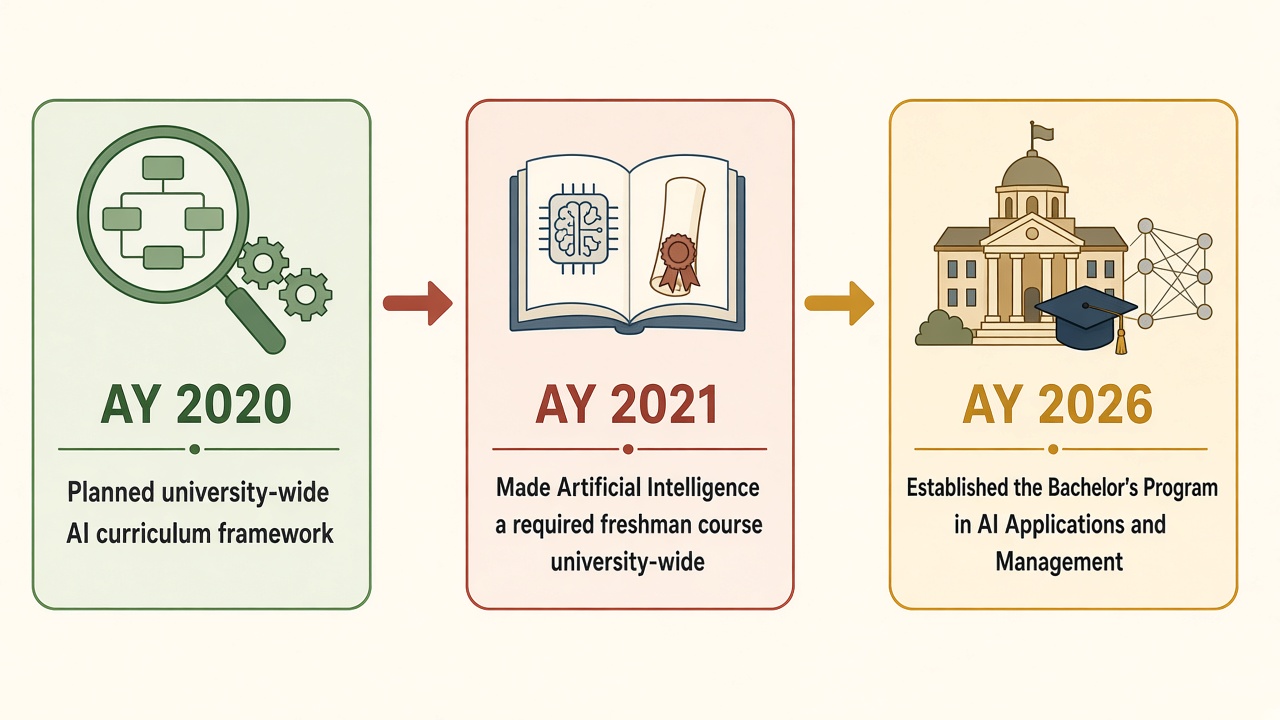
This program grew from Ming Chuan University’s sharp focus on technological change and forward-looking planning. Beginning in Academic Year 2020 (AY 109), under the visionary leadership of President Lee Chuan and successive presidents, the university began planning a campus-wide AI curriculum framework. In Academic Year 2021 (AY 110), Artificial Intelligence became a required freshman course university-wide, with Python as the core tool, laying the foundation for “AI application literacy.”
As technology advanced, the university promoted “AI application popularization,” embedding AI across colleges’ professional courses, and advanced “AI application specialization” through measures such as establishing AI-related departments. Building on the School of Management’s AACSB accreditation, and to meet strong demand for cross-disciplinary AI talent in business and management, the Bachelor’s Degree Program in Artificial Intelligence Applications and Management was formally established in Academic Year 2026 (AY 115), delivering integrated professional training aligned with global industry change.
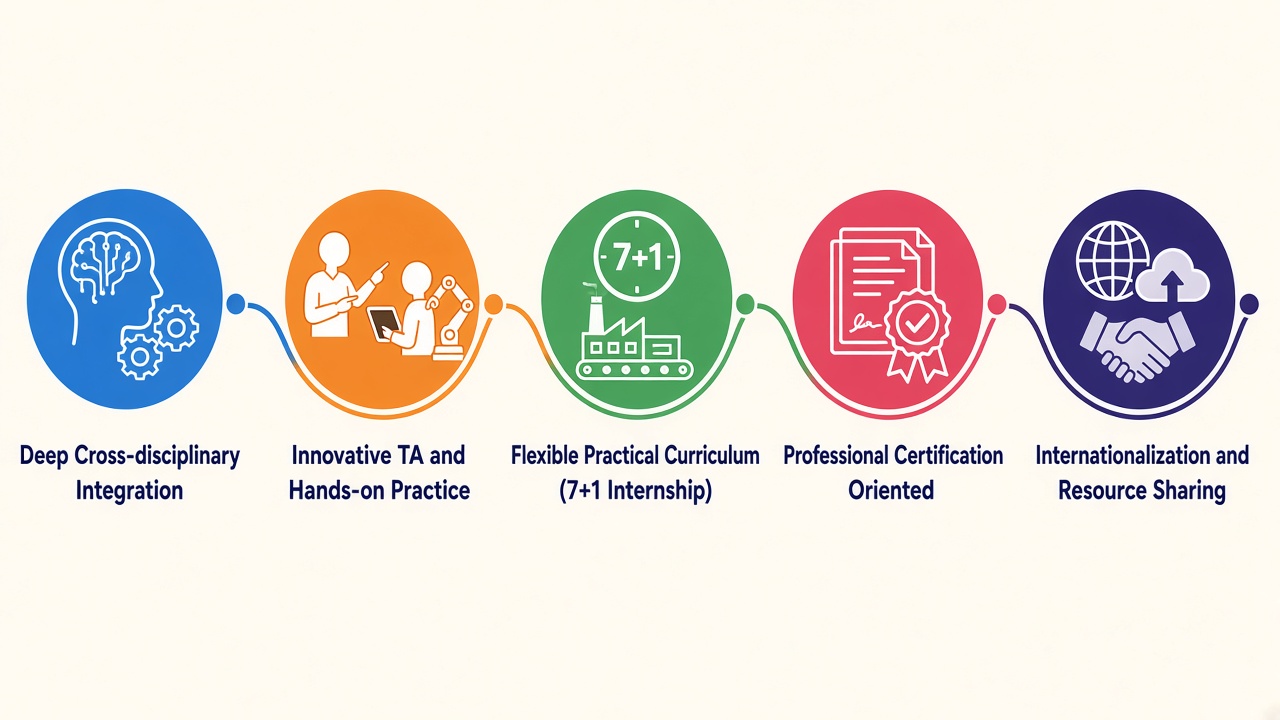
1. Deep Cross-disciplinary Integration:
Unlike programs focused only on information technology, our curriculum is organized into three modules—Advanced AI Applications, Market Analysis Capabilities, and Business Management Capabilities—so students build programming skills alongside a solid foundation in business and management theory.
2. Innovative TA and Hands-on Practice:
Outstanding senior students serve as teaching assistants (TAs) to support newcomers in AI courses, reinforcing learning by teaching. Graduation projects and international competitions further assess students’ real-world capability.
3. Flexible and Practical Curriculum:
“7+1” corporate internship: students complete a full internship in industry during the second semester of the senior year, supporting the goal of being employment-ready upon graduation.
4. Professional Certification Oriented:
The program links assessment of AI literacy, programming, and management application skills with professional certifications (such as ERP, big data analytics, and Python machine learning) to strengthen competitiveness.
5. Internationalization and Resource Sharing:
Combined with AACSB quality assurance in the School of Management and alumni network resources, students gain rich internship platforms and internationally connected learning opportunities.
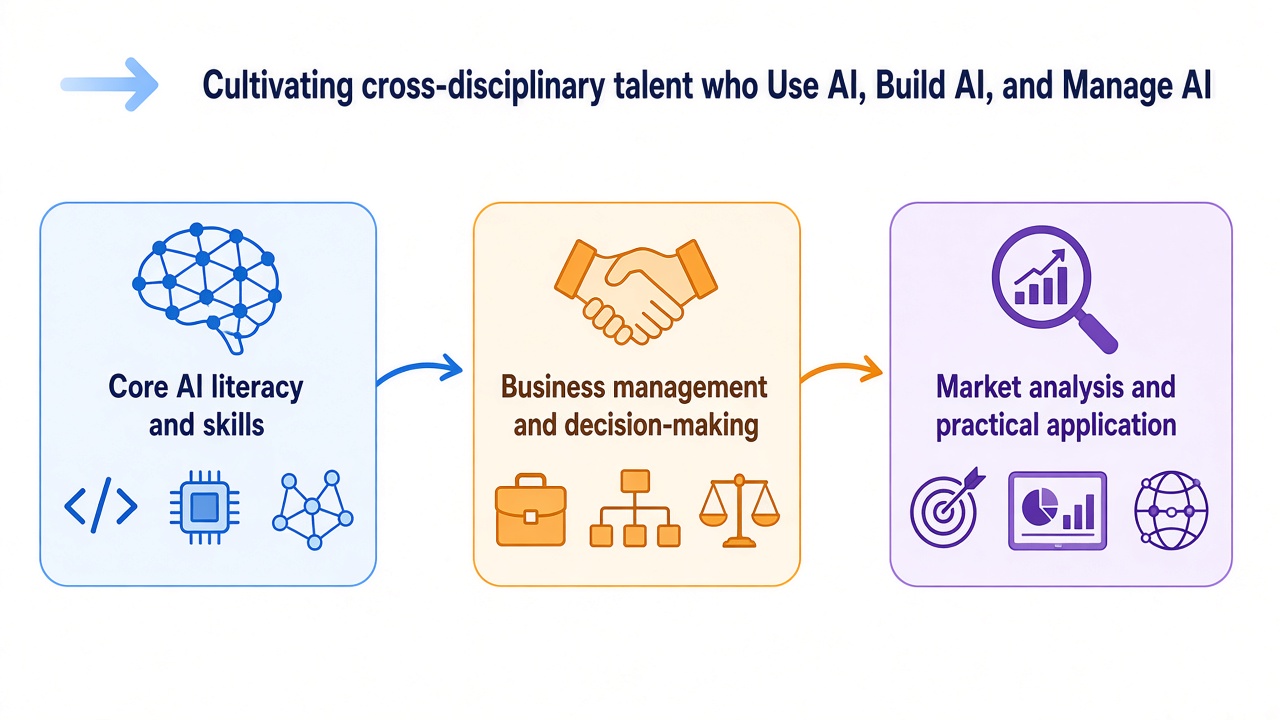
Program goal: cultivate cross-disciplinary talent who Use AI, Build AI, and Manage AI.
Our core aim addresses a common gap—information programs that lack business and management thinking—by developing hybrid talent who can apply AI to real business management problems. Educational goals fall into three directions:
1. Core AI literacy and skills:
Rather than focusing only on theory, the program builds progressively from foundations to advanced applications. Students learn programming (Python, R), database management, big data analytics, machine learning, and deep learning, so they gain both AI literacy and the ability to develop and adapt AI applications.
2. Business management and decision-making:
AI must create business value. Coursework covers management, financial analysis, supply chain management, and project management. Students learn data-driven decision-making, performance analysis, and risk assessment—developing the management capability to “Manage AI.”
3. Market analysis and practical application:
For marketing and market-facing needs, the program emphasizes consumer behavior analysis, digital marketing, CRM (customer relationship management), and recommender systems. Through hands-on courses and capstone projects, students integrate skills in data mining and visualization to address industry pain points and stay employment-ready upon graduation.